
Device financing
EMI Book
Finance the device. Keep the control.
EMI Book lets retailers offer device financing with real teeth: a financed phone's access can be remotely restricted or restored based on EMI status, with on-device schedules, offline enforcement and automated due-date reminders — reducing the risk of financing a device to a customer.
- Platform
- Web console + Android
- Domain
- Device financing
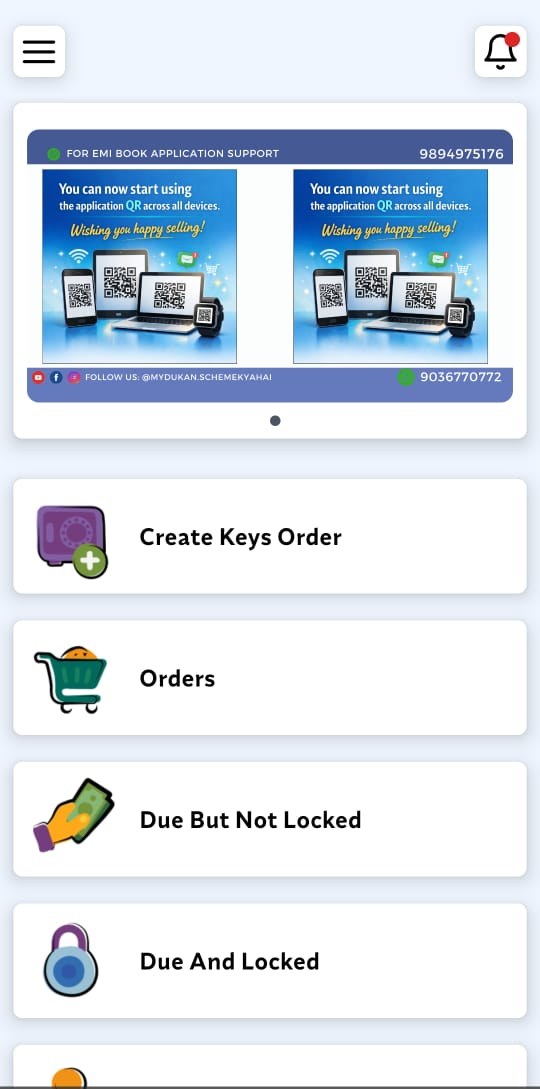
Actual product screenshot
Overview
EMI Book lets retailers offer device financing to customers while managing the risk that comes with it. A retailer places an order on the platform and is credited with “keys” — the unit that finances a device and puts it under EMI-based control. Once a device is financed through EMI Book, its access can be remotely restricted or restored according to its EMI due status, giving the retailer real recourse if a customer misses payments.
The product pairs a backend platform — accounts, keys, EMI tracking, device commands — with a device-side companion app that runs on the financed phone itself and enforces access restriction, screen messaging and other controls in line with EMI status.
The problem it solves
- Retailers financing a device have little practical recourse if EMI payments stop, short of manual repossession.
- There is no easy way to track EMI due dates, overdue amounts and payment history against a specific financed device.
- Manually chasing customers about due EMIs, or manually restricting a defaulting device, doesn't scale for a retailer financing many devices.
- KYC verification for financing customers is normally a manual, error-prone step.
Who uses it
Retailer
Orders financing capacity (“keys”) from the platform and uses it to finance and control devices sold to their customers.
End customer (device holder)
Uses the financed device, whose access is controlled based on EMI payment status, and sees their EMI schedule on-device.
Platform admin
Manages retailer accounts, monitors device and EMI status, and can trigger device commands where needed.
Key features
Key-based financing model
Retailers are credited with “keys”, the unit used to finance a device and gain EMI-based control over it.
Gives the platform a simple, auditable unit of financing capacity per retailer.
Remote access control
A financed device's access can be restricted or restored remotely based on EMI due status, via push commands to the on-device companion app.
Gives the retailer real leverage to recover payment without physical repossession.
On-device EMI schedule
The device itself shows the customer their EMI schedule with paid and due status.
Keeps the customer informed and reduces disputes about what is owed and when.
Offline enforcement
The device-side app computes overdue status and restricts itself from a cached schedule when there is no network connection.
Closes the loophole of a customer disabling data or Wi-Fi to dodge enforcement.
KYC verification
Identity verification is integrated into customer onboarding rather than handled as a manual document check.
Reduces fraud risk when financing a device to a new customer.
Automated notifications
Scheduled jobs handle near-due reminders, automatic access restriction on due dates, and inactive-device notifications.
Removes manual chasing of every account by a human ops team.
Multi-language on-device experience
The on-device restriction and home screens support multiple Indian languages.
Makes enforcement and information screens understandable to a wider range of customers.
Distributor hierarchy
A distributor-above-retailer ordering hierarchy is supported for financing brands that sell through distributors rather than direct.
Lets the same platform support both direct-to-retailer and distributor-led go-to-market models.
How it works, end to end
- 01Retailer orders financing capacity from the platform and is credited with keys.
- 02Retailer registers a customer and a device, completing KYC verification.
- 03The device is provisioned with the companion locker app, which becomes the enforcement point.
- 04EMI schedule and due dates are set for the financed device; the customer sees this schedule on-device.
- 05As EMIs are paid or missed, the platform — and the device itself, even offline — updates access status accordingly.
- 06Once the device is fully paid off, restrictions are lifted and the device is released.
Dashboards & reporting
- Retailer-facing view of key balance and financed-device status.
- On-device, customer-facing EMI schedule with paid/due status badges.
- Admin-side device and account status views.
- Notification history for due and overdue reminders and automated access-restriction actions.
Business value
- Gives retailers real leverage to recover payment on financed devices without repossession.
- Reduces manual collections effort through automated due-date tracking and reminders.
- Lowers fraud risk at customer onboarding through integrated KYC.
- Keeps enforcement working even when a device is offline.
- Demonstrates our ability to build and operate device-management infrastructure, not just a web application.
EMI Book turns device financing from a trust-based risk into a manageable, enforceable process — protecting the retailer's investment while keeping the customer informed at every step.